


Professor Hu Danian of our hospital explained the two-way role of Sino-US scientific cooperation in promoting the early development of quantum physics

Recently, Professor Hu Danian of the Center for Social Sciences of our Institute was published in the International Academic JournalNature Reviews Physics A review paper entitled “US–China collaboration as a catalyst for the early development of quantum physics” was published in.
This paper aims to systematically demonstrate and re-evaluate the key contributions of a group of Chinese physicists who have long been overlooked by the narratives of the history of mainstream physics in the West. As a scholar who has been deeply involved in the history of modern physics and the history of science and technology for a long time, Professor Hu Dainian cuts through the unique perspective of the history of science and society, reviewing and reviewing the two-way role of Sino-US scientific cooperation in the early development of quantum physics from the 1920s to the 1940s.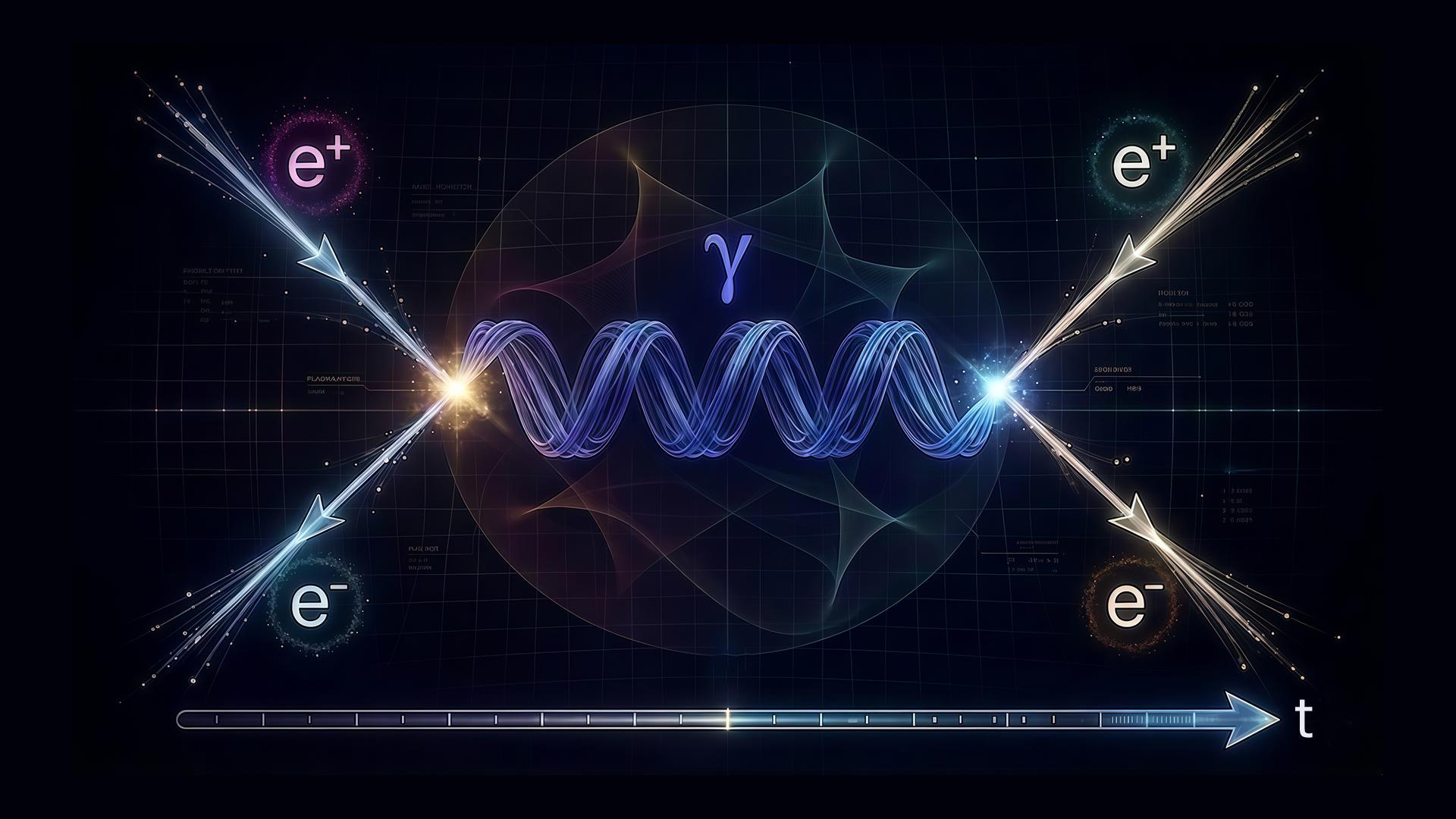
Feynman diagram of positive and negative electron pair annihilation process
The article pointed out that at that time, American university institutions helped China train the first batch of modern physicists. However, Chinese scholars who come to the United States do not stay in the passive acceptance of knowledge, but with excellent creativity and independent research capabilities, they are directly involved in the frontier exploration of American physics. However, many of their pioneering contributions are little known in Western physics. For example, Wang Shoujing was not only one of the first five PhDs in theoretical physics to study quantum mechanics in American universities, but also used matrix mechanics to take the lead in deriving formulas to solve the problem of asymmetric gyroscope energy levels and publish them before his European counterparts, which made the American physics community quite proud. The precise experimental results first published by Zhao Zhongyao laid a solid foundation for the subsequent creation and annihilation of positive and negative electron pairs, and also helped to establish the controversial Dirac theory at the time. And Xie Yuming and his American colleagues' precise measurement of the fine structure of the hydrogen spectrum revealed anomalies, which was actually the first sound of Lamb's displacement, revealing the flaws of Dirac's theory. Mr. Yang Zhenning believes that the work of Zhao Zhongyao and Xie Yuming is the most important contribution made by Chinese physicists to physics in the first half of the 20th century. However, unfortunately, their pioneering contributions have been buried for a long time due to the erroneous assertions of some Western physics authorities, and have not been fairly evaluated.
More importantly, after returning to China, these Chinese physics pioneers established a systematic physics discipline system and talent training mechanism in the motherland, and cultivated a group of outstanding young physicists, including Wang Mingzhen, Wang Chengshu, Juning, Yang Zhenning, Li Zhengdao, etc. The latter went to the United States to further study and made better contributions, thus forming a "academic cycle" across the Pacific Ocean and continuously promoting the progress of global physics.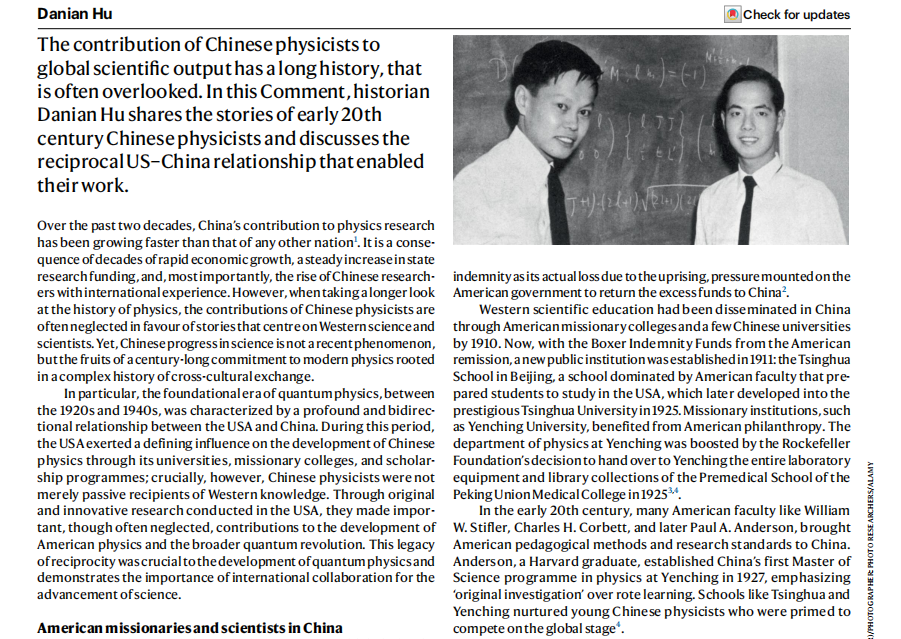
In this period, the history of scientific and educational cooperation between the United States and the United States highlights the power and mutual benefit of international academic exchanges. The excellent research results of Chinese physicists in the United States prove that scientific progress is never a solitary struggle or narrow-mindedness, but an open and collaborative human common cause.
The study mirrors the “center-edge” bias that exists in the writing of the history of science. Contributions from researchers in non-Western scientific centers are often overlooked or even encroached upon. Finding these “missing” pioneers in mainstream narratives and rediscovering their forgotten work is both a restoration of historical justice and an urgent call to build a pluralistic and inclusive global scientific community.
Hu Dainian is the first author of the paper, and SUSTech is the first unit of the paper. The research work was supported by the Shenzhen Municipal Research Start-up Fund.
Link to the paper:https://www.nature.com/articles/s42254-026-00933-w
This article is from: Center for Social Sciences, School of Humanities and Social Sciences, Southern University of Science and Technology


